Thursday, 22 March 2012

The Healthfulness of Cereal Packets


Less You
Peanut butter continues to pervade American cuisine. You might have noticed that I’m already on my third different peanut butter cereal here. There’s peanut butter in many of the sugary chocolate treats. The PB&J is the standard food for parents who can’t work out what to serve. And really, it’s a very, very good choice: I believe that you can get all the nutrients you need to survive if you eat enough PB&J sandwiches. Although I am also told that you can also get your daily recommended amounts of every vitamin, mineral, carb, liquid, salt, and so on, from 19 pints of Guinness and one glass of orange juice.  So perhaps being able to get all the nutrients you require shouldn’t be your sole criteria on what to serve.

I am complaining again about different specious health claims today, also peanut butter related. Today I’m writing about Peanut Butter Cheerios. And, I will be honest, I haven’t much to say about them. This is in part because Beth ate most of the pack whilst I was eating other cereals. It is also because they’re pretty unremarkable.

They’re like Cheerios, with a little bit of peanut butter flavour. That is it. There’s not enough peanut butteryness. But they’re not nasty. There’s nothing actually wrong, but also nothing in the least bit exciting. I’m hoping that perhaps some others in the incredibly varied Cheerios line – at last count I saw something like 10 different varieties of Cheerios on the shelves – will turn out better.

One thing that we did discover they were good for was mixing in to other things. Into fruit salad or yoghurt to give a bit of texture, without being overwhelmingly sweet, or offensive, like other cereals are. But that’s damning with faint praise: I should be judging them as a breakfast cereal and, whilst not failing the test, they aren’t bringing any great excitement to the party.

Less Peanut Butter
On to my specious healthfulness whinge. I notice on the pack that we have a claim: “More Grains. Less You.” Is there any plausible explanation for how more grains makes you lose weight? Do you drop the pounds by eating corn and wheat? Or is it the whole-grain-ness? Perhaps fiber makes you shit more, but surely that isn’t a sustainable method of losing weight.

Sure, fiber’s good for you.  I wouldn’t dispute that. But there’s a very big difference between healthy and slimming.

It seems to be part of the classic stylings of the cereal packet: to make claims that are sufficiently vague that you can’t quite pin them down for being misleading, but which if you examine them in any detail at all, even in their vaguest form they seem to be utter nonsense.

It turns out that Cheerios (as I guess most people in the US know) have decided to work hard at their vagueness. In the past they’ve been told by the pharmaceutical regulation body to change the wording on their packets. They had claimed that Cheerios helped reduce cholesterol. And that meant they were marketing themselves as a drug. And that meant they had to undergo far, far stricter tests  and guidelines than just being something people eat.


Cheerios, unsurprisingly, walked back from that precipice very quickly and have toned their language down to much more unproveable claims.

Wednesday, 21 March 2012

Boringcomb


Excellent source of boredom
A couple of weeks ago we left Palm Springs after staying there for a month and a half. We really enjoyed our time in the desert, with the fantastic San Jacinto mountains looming 10,000 feet over our heads, the almost omnipresent beautiful weather, the stunning cactus and desert scenery, the golf and some beautiful modernist architecture in a ton of residential homes.

From that, you’d think that I loved Palm Springs. But that would be a slight misapprehension. Greater Palm Springs is an area that has nearly half a million residents. Palm Springs, the town, has a mere 40,000 or so. And whilst we enjoyed being in Palm Springs city, and whilst we loved being in the desert, the greater metropolitan area is dreary.

It holds so much promise: 125 golf courses (but they all look the same, have nothing to do with the desert, and cost a fortune). The newer, shinier, more recently built houses – but if you thought they’d carry on with the cool modernist aesthetic, you’d be mistaken; instead they’ve just plonked down McMansions or miserable retirement communities on the golf courses without the slightest thought for how it might look. There are a ton of restaurants, except they’re all chains, or bad steak houses. It’s just a whole lot of nothing. There’s no “there” there.

Which brings me, as a tenuous link, to Post’s Honeycomb. Kerry visited us in Palm Springs and generously bought a couple of packs of cereal for me. This is the first, and I was excited. You’d think an American breaksfast cereal called “honeycomb” would be awesome: sweet, crunchy and wonderful. Perhaps like a delightfully bad-taste version of a Crunchy.

Sadly not. It is the cereal equivalent of greater Palm Springs. It is deeply underwhelming. It has no character. No excitement.

A bowl of Meh
The cereal itself is hugely puffed up, and massively inflated (the only cereal so far where a portion is a cup and a half, because so much of it is air). It’s shaped more like cartoon snowflake than honeycomb. This gigantism is actually really annoying, as it’s hard to shovel it into the mouth fast enough. And you get very little of any note with any bite.

The texture is OKish, but no better. It’s crunchy, which is good. But it’s not that nice, biting crunch. It’s a bit soft and airy. It’s not quite like eating Styrofoam peanuts, but it’s not far off. If you go halfway between a Styrofoam peanut and some stale toast, you’re probably on the right tracks.

The flavour too is sort of OK. But that’s as good as I could say. It wasn’t offensive, but it was very mild. Although there was honey, there wasn’t very much of it. Although there was cereal, there wasn’t much. Mostly there was little flavour at all, and at the base it was that bland, cardboard taste that seems to be the root of some of the worst cereals here.


As I mentioned already, it’s the cereal equivalent of Rancho Mirage or Indian Wells. You think it all sounds good, the component parts all look great,  but it is so much less than the sum of its parts, just leaving you bored and disappointed.

Saturday, 10 March 2012

The Golden Years


Box of Golden Grahams

Long ago, back in the 1970s and 80s at the fag end of the cold war, Britain was covered in US Air Force bases. Full of F14s and B52s and Tomahawk missiles holding the second line against the coming Soviet invasion, able to strike back once the tanks started rolling into Germany. It was a strange era. Every time we heard the F111s flying out of Upper Heyford we thought the nuclear Armageddon had started.

As well as containing the tools of the imminent demise of mankind, these places also contained shops. Shops stocked with all the obscure US products that you couldn’t find in the UK; and not only that, they were highly subsidised.  It was rare to find an opportunity to get inside a base, except when there were airshows, and then access was restricted. But every so often we managed. To  us, as a family, where we had spent some time in the US in my extreme youth (and my parents had spent longer before I was born), it was a treasure trove of incredible excitements such as grape soda and Budweiser. It’s bewildering to think that I was actually delighted to find these things. The world was much less global back then.

Amongst the things we tended to buy, on those rare but happy visits to the USAF’s shops, were Golden Grahams. I have no recollection whether my parents discovered these in California in the 60s, or much later on future trips to the US, but I do recall them occasionally making it into our cereal cupboard and being a rare and much loved treat.

So how would they fare when I came back to them so much later? A lot of things I loved as a kid are the kind of thing that you might love as a kid but which are actually pretty nasty to an adult palate. The Golden Graham’s pass the adult palate test pretty well.

Nostalgia for Upper Heyford
I’m sure they’re entirely familiar to my US readers, but UK readers are probably not so familiar. Graham crackers are, well, a cracker made out of wheat. Not too strong in flavour, but quite earthy and a little sweet. They’re the basis for the legendary smores that we often hear of in the UK, and in that regard perhaps the closest analogy would be a digestive biscuit. Certainly in terms of ubiquity.

As a cereal they’ve used Graham cracker material and made it into a Shreddies like lattice. The “golden” part of the name is a honey addition.  It’s not the usual lightweight honey you often get in cereal but a darker, almost burnt sort of flavour, bordering on being caramelised. The cereal is like an unmalted Shreddies, I guess the caramelised honey replacing the malt.  And it’s great. It’s really, really good.
It’s a dense cereal, one that sinks, that’s filling, that tastes good. It tastes like it’s made from real stuff, not from the magical chemicals in a lot of US cereal. It actually sets you up nicely for the new day.

There’s something earthy here in the graham cracker which works fantastically with the burnt honey, giving a great full flavour and just a hugely satisfying feeling when eating it. I can see entirely why we used to be so excited when we found them.


Frankly delicious, and something I’ll be revisiting once I’ve emptied the rest of the cereal aisle.

Tuesday, 28 February 2012

The First Deadly Cin


Cinnabons
There’s a whole category of cinnamon based breakfast cereals in the US that don’t seem to exist in Europe. It’s an omission that I fail to understand, because cinnamon is a great friend of those who like sweet flavours and don’t want to be overpowered by sugar.

The first of these that I am trying is Kellogg’s Cinnabon cereal. Cinnabon is absolutely everywhere in the US. I think you can find them occasionally in Britain, usually in those giant soulless shopping malls that surround London. They tend to run little stands and sell cinnamon buns, as the name might imply.

These are big, doughy buns absolutely smothered and swamped in sugar, with cinnamon as the least unhealthy element in the mix. And they’re delicious, if overwhelming.

In the US, the cinnabon has escaped the mall and is now all over the grocery stores, in all kinds of frozen bread products and, I suspect, in coffee creamers and coffees and probably cookies and I wouldn’t be surprised if there’s a Cinnabon pasta some time soon.

Why anyone thought it was a good idea to create a breakfast cereal out of these is beyond my understanding. It is, I think, a lack of imagination on the part of US cereal manufacturers – something I can’t normally accuse them of – to desperately try and make a breakfast cereal out of something else (see: Eggo Waffles, Reese’s Puffs, previously).

This time they’ve actually done a very good job. The Cinnabon cereal is genuinely delicious. They’re miniature versions of the cinnamon roll, or perhaps mini-Princess-Leia-hairs (and would be a good suggestion for anyone who is trying to make edible Star Wars characters...), and therefore look a little odd.

In terms of flavour, they’re sweet but not as sweet as the Cinnabon buns – either that or you eat them in small enough portions for the sugar to not completely overpower in the way that the buns do. And they don’t have that stickiness of the sugary frosting which helps.

The texture overall is pretty good. They’re crunchy, and stay crunchy in the milk. They’re not too aerated and therefore don’t float, which means you can get at the milk beneath. There’s a density that means they’re actually fairly satisfying to eat.

The remnants of a lego Leia genocide
The cinnamon flavour is quite strong, but not so much that it gets up your nose. You can just about taste some kind of grain at the base of the cereal, too, which is something I like; something that makes a breakfast feel breakfast. I like the fake sugary notes, but I prefer them to be balanced with just a little bit of something real (although here, not so real that I could actually tell you what the grain at the base of the Cinnabon is).

So, here we have something of a winner. It tastes good, it has a good texture, it’s pretty artificial and stupid. It seems to score highly on all counts. 

Thursday, 2 February 2012

Nobody Can Eat Three Mini-Wheats


Mini box of Mini-Wheats

Back in the late 70s and early 80s, and maybe before (but I’m too young to know) there was a long running advertising campaign featuring what appeared, to the undiscerning British eye, globe bestriding sporting colossuses (colossi?) such as Brian Clough and Ian Botham claiming that “Nobody could eat three Shredded Wheat”.

Back then, in Britain, the only size of Shredded Wheat was massive, fist sized things. Over time, Shredded Wheat bite size came to dominate, to the extent that I can barely remember the original full sized ones.

Over here in America, Beth decided to buy me – to help with this mission, although I don’t know if it’s cheating – a selection pack of single serving sizes of various cereals. The first one I went for was the Frosted Mini Wheats.  Now, I’ve had a long, rigorous survey of two, maybe three supermarkets, and I’ve not noticed any full sized wheats. Perhaps America only actually has mini-wheats, although the name would seem odd considering that most companies aren’t desperate to advertise the mini-ness of their products, unless the mini-ness is in comparison to a previous version that was unwieldy – like the previously mentioned original Shredded Wheat.

Mini-portion of Mini-wheats
Upon opening the box, I was taken back to that advertising campaign of my youth – because a single serving of Mini-Wheats (frosted) seems to have about three shredded wheat. It’s a shockingly tiny portion. Now, I’ve been mocking serving sizes all through this, but this is just farcical. Nobody can eat three mini-wheats, because they don’t put three in the box.

The size issue aside, which can be easily resolved by buying a normal box and pouring out a proper sized helping, the mini wheats are actually very good. But we all know that. I think everyone the world over knows the plain, fairly pleasant wheaty flavour and how it desperately needs sugar to stop it tasting like cardboard; and how the strands of the wheat can be desperately, inedibly dry without milk, but can turn to a mush when left in too long. But in that exact moment of perfect balance, turns out to be really delicious.

On the positive side of the single-serve packet, there are much fewer of the crumbs in the bottom that make the last helping you get from a normal package turn into something the consistency of wallpaper glue.

Anyway, here’s a short review in honour of the tiny portion of cereal. Perfectly nice, very familiar, the kind of cereal you could eat every day for breakfast but not the kind to get you giddy with excitement.


Tuesday, 24 January 2012

Andy’s Southern Breakfast Companion


If I had any loyal readers, and if they were still reading after such a long break, they may have been wondering why there have been so few posts.

There are a number of reasons, amongst which are that I’ve actually been working hard (the pretty animation at the top of this news report is mine: http://www.bbc.co.uk/news/science-environment-16657122) ; and that I’m incredibly lazy about writing. Primarily, though, it’s because we were travelling a lot, and in particular travelling in the South. Which means both lots of breakfasts out, and also lots of the specific foods of the American south.

Americans reading this will wonder why I’m bothering, but the people of Britain are often baffled by southern breakfast foods which sound, to the British ear, utterly nasty. Why would people eat grits, we wonder? It just sounds bad. What on earth would possess you to put gravy on your biscuits?

I hope I’ll be able to add just a little extra layer of information.

The Biscuit Confusion

Some biscuits, yesterday
First up are biscuits. Back in the UK, biscuits are cookies. On the whole, biscuits are dry cookies – perhaps the closest thing in the US are Graham crackers. The idea that you’d eat them for breakfast is a bit odd. The thought is putting fried chicken between them is baffling. And the concept of covering them with gravy really churns the stomach.

Here in the US, biscuits, which are now pretty universal but which started as a southern speciality, are bready, soft, buttery delights. The closest UK equivalent is the scone, I’d say. But it’s a scone that’s not sweet, and which is lighter and made with much more butter (as well as with buttermilk rather as the base). Frankly, the best biscuits are made mostly with butter, with just a thin fabric of flour holding them together. Eaten warm, they melt in the mouth and are utterly wonderful.

These days, as I mentioned above, they’re getting to be ubiquitous – you can get them in fast food restaurants, in KFC and McDonalds and the rest, and if there’s any justice in the world you’ll be getting them in the UK soon  - but traditionally they were eaten in the south with gravy. The gravy here is not the dark, beefy, Bisto kind of gravy we’re familiar with in the UK. It’s much lighter, basically a white gravy, made with a flour base, and ladled over the biscuits to soak them. Now, this can be a bit more of an acquired taste, particularly as the gravy is often made with sausage meat and then given a bit of spice. Personally, I find it pretty delicious, but it is a very fatty gravy, and not to everyone’s taste.

Grits

Uncooked, unappetising, grits
For Christmas, Beth bought me the selection box of grits from Quaker. It is appropriate that they’re made by Quaker because porridge really is the obvious comparison. Grits are best described as a corn meal porridge. It’s a fairly coarsely ground corn meal heated in milk (or water, I think, for the purists), and comes out with a vaguely gritty, crunchy texture - a bit like slightly undercooked rice.

Beth reminds me that perhaps the other really close comparison is polenta. Grits are very similar to polenta.

The flavour is pretty bland on its own, although like biscuits they becomes a good vessel for carrying butter to the mouth. This means that plain grits appear to be all about the texture which – like sausage gravy - appears to be pretty polarising – some love the texture, some really hate it, although oddly I find myself a bit indifferent, really. The Quaker variety pack comes with pre-flavoured grits, though – some plain, some butter, some cheese and some bacon. I’ve not yet dared to try the bacon after the astonishingly nasty fake-cheese flavour on the cheddar version, which I’d really suggest that all sane people avoid.  They’d probably be great with real cheese, mind you. The pre-flavoured butter ones work well, so I guess it’s just a case of making sure you get the right fake flavours.

Cooked, still rather charmless, grits
Beth tells me a sort-of-entertaining story from 1990s southern Africa. Grits are made with ground yellow corn, and the mealie-pap that is common across southern Africa is ground white corn. During a period of famine, US charities sent large amounts of grits as aid but because they were the wrong colour apparently they were turned down, under the suspicion that the US government was messing with it and trying to kill them.

Hoecakes

Another food item that would have bad connotations to the English, this is not actually anything to do with prostitutes. I have learned that the Hoecake is actually identical to the Johnnycake and is not a southern speciality at all. It’s just that the term Hoecake is a southern usage. It appears that they start off fairly similar to grits, as corn-meal, but are then cooked on a griddle.

Traditionally, in the south, they were cooked on hoes in the farms, which is how they got their name.

Ho, ho, hoecakes
We only had them one evening, at Paula Deen’s restaurant in Savannah, so I’m not sure they’re actually a breakfast food.  They were very delicious, and certainly taste like they should be breakfast food. Fried and cornbready and delicious and probably wonderful with butter and maple syrup.

Again for the British readers, a few words on Paula Deen: she is a pretty ubiquitous TV chef who’s schtick appears to be “add lots and lots of butter and sugar to everything, and that will make it delicious, y’all”, which is an entirely fair point, but seems a little shallow to have built an entire culinary empire on. Then again, Jamie Oliver has built an empire on “buy really good fresh ingredients, and then don’t cook them too long, and they’ll taste great”, so perhaps the public need spokespeople for the blindingly obvious. Miss Deen, meanwhile, recently announced that she has diabetes, which some view as ironic. More ironic, perhaps, is that I think I heard she’s now a spokesperson for a diabetes drug: given that she has spent her career encouraging people to eat a diabetes inducing diet. If this were politics, someone might call “conflict of interest”.

Beignets

Finally, something that doesn’t sound nasty to British ears, these are a speciality of New Orleans. Like the French suggests, they’re basically doughnuts, but in New Orleans, they’re fried, square pillows of dough, very, very light and smothered in powdered sugar. And like most of the other things I’ve mentioned, utterly delicious – although they’re served with the very disturbing chickory coffee that seems popular in New Orleans, too, which brings them down a notch.

A word on bacon

This is just another note to British in America, and not a specifically southern thing. You can’t get back bacon here. Don’t bother trying. All bacon in America is streaky bacon (which is also delicious, and generally cooked until it’s very crunchy). They might try and tell you that Canadian bacon is back bacon, but it’s not. Canadian bacon is perhaps more similar to ham than to back bacon. It’s closer than streaky, but it’s definitely not the real thing.  So, Britons in America, I suggest you just embrace the lovely, crunchy, thin streaky bacon of the US when you’re here, be a bit sad that you’ve lost all the great bacon variety that you’re used to, and enjoy back bacon when you’re in Blighty.

-

Well, after all that, it’s time to get back to the regular programming and some writing on immensely sugary American breakfast cereals because the drive across the country seems to have shrunk the waistband on all my clothes and I need to start the fightback.

Sunday, 8 January 2012

Crunch Time


A packet of crunchy goodness

We’ve been in the Deep South: Savannah, Georgia. Georgia is famous for its peanuts, for Planters Peanuts, for Jimmy Carter, Peanut Farmer. Savannah, meanwhile, is an old, stately, coastal and port town. It still has a large fishing fleet and huge container boats coming in along the river. It’s stunning to look at, full of trees covered in Spanish moss and old brick pavements (sidewalks for the Americans). Its wealth originally came from its place as the export port for all the slave picked cotton.

So, in a world of peanuts and boats, what better way to honour where I am than eating a bowl of Cap’n Crunch Peanut Butter Crunch. The original Cap’n Crunch is one of Beth’s absolute favourites, the only cereal that got shipped back to the UK with us. We’ll no doubt come to Cap’n Crunch Original later, but it does mean that I had some preconceived notions. These weren’t so much about the taste than about the Captain (or, I think I mean, Cap’n). In my mind he was a pirate. I would think kids would be excited for Pirate Cereal. It turns out that the Cap’n is a more modern seafaring Captain, and looks like he’s on a fishing boat (for British readers, he has more of the disturbing Captain Birds-Eye tendency than the violent Blackbeard tendency).

I’m not sure that the kids really want fishing boat cereal. The idea of stinky fishing boats, of rotting herring, just won’t lure in the children, I’d have thought. But the brand seems to be massively popular.

Rightly so, it turns out. Cap’n Crunch Peanut Butter Crunch is pretty much delicious. It’s by far the best of the fake, fun, kiddy cereals I’ve had so far. It lives up to its name, too. The crunch is spectacular. I think I disturbed the neighbourhood eating my way through it.  I don’t quite know how it’s achieved, but the cereal seems to be very dry as a basis, and not nearly as absorbent as some, so it remains very, very crunchy in milk.

The flavour is great, too. It’s peanutty, perhaps more peanut than peanut butter, but I’m not going to fuss about those kinds of details – we’re again, as we were with the Reese’s Puffs, in the same flavour space as the cacahuette puffs that you get in French supermarkets and on bars in Germany. It’s a good peanut, too. There may be lots of sugar in the cereal, but it’s acting as a flavour enhancer, I’d say, rather than as a flavour disguiser.
A bowl of crunchy yum

Somewhere beneath the sugar and peanut is a cereal base, but it’s too swamped by all the other stuff for me to really be able to identify it. Whatever it is, and I’m sure I’ll get to it when we get around to the real Cap’n Crunch, it’s not detrimental to the whole.

One really nice thing about the Cap’n Crunch experience was the aftertaste. For once I wasn’t left with the brutal acrid acid burn in the sides and back of the mouth. It actually felt fairly benign.  I do suspect, though, that if I hadn’t had a second breakfast I would have suffered from a chronic sugar crash.

A good way of overcoming this was to mix the Cap’n Crunch Peanut Butter Crunch in with the Wheaties Fuel mentioned in an earlier posting. Mixed together they make a really fantastic breakfast cereal, a mix of fun, sugary, serious, healthy and filling.


All told, the Peanut Butter Crunch turns out to be surprisingly and genuinely nice.

Friday, 23 December 2011

Turning Trix


Box of Trix

We are, at the moment, in Charleston, South Carolina. It is a very pleasant city to be in. At least, it is in winter when the humidity and heat and mosquitoes aren’t out of control. We are told that in summer it turns worse. For the time being, though, it’s pretty delightful. It has the feel, the air, of a Caribbean city, but better maintained, and with more wealth and most of the luxuries that make living in the US easy. It’s full of great restaurants – lots of farm-to-table southern cooking, but refined and elevated. It may have even more really great bars making interesting, but still good, cocktails. It’s easy to get around. The houses are lovely and old and full of character. It’s surrounded by a beautiful harbour full of dolphins. It is, really, a very, very nice place indeed.

Yesterday, on a drizzly day, we decided to take a day trip to Myrtle Beach, which we knew was a beach resort on a strand, but didn’t know much else. It is grim. Grim, grim, grim. A hugely unpleasant, soulless place. It reminded me mostly of pictures of those Spanish resort towns that the British infested in the 1980s. A waterfront of ugly, tall, identikit concrete hotels, with no character whatsoever, it was even hard to see the ocean despite driving Ocean Boulevard. The overwhelming characteristic was of decay – these were hotels put up 15 or 20 years ago that have had no maintenance done since. One core characteristic was swimming pools full of faded and chipped waterslides that had once competed to be the most ludicrously over the top and tacky. They often go for a theme, like Polynesia or aquarium, but sometimes just for abstract art. So you sometimes see a lime green shark that a child will slide out of the mouth of, or a purple octopus that they’ll shoot  down the legs of. And sometimes you’ll see something like 30 year old bad Austrian municipal public art, all electric colours and lightning flashes and spheres. This being mid-December, everything was shut. I’ve had a penchant for off-season resort towns for a long time; but Myrtle Beach had none of the charm. There was no waterfront to play on. The shops and restaurants weren’t open even in the hope of getting the passing trade of rubberneckers like me. It was grim.
My eyes hurt just looking at the back of the box. Ow.

Trix Fruitalicious Swirls are definitely more Myrtle Beach than Charleston. They are unutterably nasty. They are deeply unpleasant - and the ugly swirls remind me of the garishly coloured and nasty pools and waterparks.

Trix is, itself,  a brand of cereal here in the US, with quite a lot of history, or at least cultural background: Beth has repeated the advertising tagline “Silly Rabbit, Trix are for kids” to me many time. But I’ve not tried them yet, so can’t compare the Fruitalicious Swirls with their parent cereal. The most obvious comparison for me is with Froot Loops, which I wrote about a while back.

At first taste, Trix Fruitalicious Swirls win. Not just on the spelling of Fruit, either. The actual flavour is better. It’s marginally less artificial, and there’s an underlying cereal flavour which didn’t exist with Froot Loops. There’s something that’s actually holding the chemicals in place.

That said, they’re still not great. The fruit flavours are pretty foul, and fake. And the colours are scary – looking like a mix of diseased sloes and mushy peas and over-seasoned cheesy puffs. They leach out into the milk. After a while, the colours all merge to make a sort of pale puce, or washed out mauve. That is the more appealing side. Before the colours merge, the individual separate colours seep out in to the surrounding liquid so you see a blue halo of milk around the blue cereal. And if there’s one thing I know in life, it’s that milk shouldn’t be blue.

Would you want your children eating these? Really?
Whilst I was eating them, the swirls seemed just about tolerable. In the minutes afterwards, though, things got much, much worse. The residue that was left behind in my mouth, of chemicals and sugar, created flavours and sensations that I don’t want repeated. There were  smells that I’m pretty sure Beth doesn’t want to happen ever again; a lot of acid and chemical that couldn’t be got rid of,  even with a lot of brushing of teeth, and tongue, and mouth, and with mouthwash.

The nutritional value, too, appears to be nil. No more than an hour after breakfast, on our drive towards Myrtle Beach, I felt like I’d not eaten for weeks. I was famished. I’m pretty much convinced that the Trix Swirls had dissolved as sugar and chemicals, and had performed no useful function for my anatomy whatsoever.


There is no old world charm about Trix Fruitalicious Swirls. They are nasty, overwhelming, soul destroying, modern but without any modern appeal, and they leave a gruesome aftertaste: they are definitely the Myrtle Beach, not the Charleston, of breakfast cereals.

Blegh.

Sunday, 18 December 2011

Breakfast of Champions


Athlete, pre-race

When I started thinking about writing this blog post, I was going to head it up “Breakfast of Champions” as a mocking sort of title, taking it from Kurt Vonnegut’s novel of that name. It turns out that the joke is on me.  To prove quite how much I’m coming to the US cereal scene blind, I was completely oblivious to the fact that “Breakfast of Champions” was the tagline of Wheaties, the cereal I was about to write about.

I was going to call it Breakfast of Champions because it had fuelled me to a moment of sporting triumph.

We’d arrived in Pigeon Forge, Tennessee – the home of Dolly Parton. It’s the Las Vegas of the hillbilly country music south, but without the drinking or gambling. It’s all bright lights, crappy amusement centres, bad hotels and Dollywood. Dollywood actually has some great rollercoasters, but the clientele could have lived up to every cliché. Few teeth, bad hats, plaid shirts and an excess of religion.

Along with all the tat, Pigeon Forge is also the gateway to the Great Smoky Mountain National Park – the setting is pretty stunning.  And it was where the first Smoky Mountain Santa Hustle was taking place. Beth, like the sadist she is, had entered me into a 5km race, along with Skip and Mark who’d joined us for Susan’s 40th. I’d never run a serious, group race before. My natural pace is very, very slow. The omens were bad. Even worse when I knew I had to run in a Santa hat, and I was going to start wearing a Santa beard, the morning after a big blow-out 40th birthday party – the county may be dry and alcohol free, but our cabin was not.

But, on the morning of the race I had a bowl of Wheaties Fuel. [Beth suggested this edit:] My gorgeous and brilliant wife (who I wrongly accused as a sadist in the paragraph above) had selected it for me especially for the raceday having a better understanding of what good American cereal is and a little sick of me going for just the most outrageously coloured boxes. Along with a number of other benefits, it definitely got me to the finish, and fast, under 27 minutes. 9th in my age group. Now, 9th might not be considered “champion” by some. But when your expectations are as low as mine were, it’s a massive achievement. 

Before I get on to the Wheaties, though, I’d better run through the other things that may have improved my performance:
-        I had a bit of a hangover, and perhaps the booze was still in the system
-        Running with Mark and Skip who paced and pushed me brilliantly
-        A peanut butter Clif bar, possibly the best tasting and textured energy bar I’ve ever had
-        Ice cold weather (substantially below freezing) meant you’d better run fast enough to stay warm

For the time being I’m giving credit to the Wheaties Fuel. These aren’t the traditional Wheaties. They’re one of the many subcategories of cereal that exist in the US.

One actual portion of breakfast
One great thing is that unlike a lot of other cereals, they aren’t trying to prove some kind of worthiness or low-calorieness. There’s much less of a lie about them. They know they’re full of calories and don’t really care. The crazy high sugar cereals of the US claim to have “120 calories” in a serving, Wheaties Fuel says bollocks to that and admits to 220 or so. It’s still the same sized portion – ¾ of a cup – but it’s high density, heavy and lovely, unlike the puffy things which are all air, inflated, meaning that ¾ of a cup weighs about 2 grams.  Laughably, of course, 120 calories isn’t enough for breakfast. It’s 1/10 of the amount of calories even the scrawniest dieting freak supermodel needs for a day. And breakfast is meant to be the biggest meal of the day. It’s a world of stupid out there.

Not Wheaties Fuel. They actually do what they’re meant to. They give you enough to get going.

And not only that, they’re delicious, too.  They’re by far the best cereal that I’ve had so far on this trip. There’s a heavy wheaty, cereally thing, in the flakes (apparently bran). And there’s something like puffed rice, but thinner and crunchier. The flavour has something malty in it, and some honey (Beth says that I sound like I’m describing a beer, which might be why I’m such a fan). It’s really, really nice. Not too sweet, but sweet enough to be edible.

Basically, Wheaties Fuel seem to be fantastic.

 I am told that there are sports champions on the Wheaties box, and that pretty much every kid in the US takes up sports not so that they’re obsessed with winning the 3 man coxless luge in the Olympics, but because the Olympic gold medal would give them a chance of a place on the box – but I don’t think I’ll be getting my face on a packet any time soon. 9th place in the 40-45 age group in a field on 1000 runners is great, but not quite that great.

The next Wheaties box

Tuesday, 29 November 2011

Bearly Anything.


Granola, at last!

After weeks of eating sugary and fake cereals, I finally succumbed to my craving for something a bit more normal for me. I needed muesli or granola. Something made with real oats, where I could actually identify the ingredients, full of slow-burn complex carbs, which would fill me up for more than a few minutes.

Bear Naked brand of granola has seemed to me to be the dominant high-quality granola on the shelves here in the US. The price certainly suggests quality, so I’ve gone with the Bear Naked Fit Vanilla Almond Crunch granola. That’s surely a bunch of words put together where you can’t possible go wrong.

Well, I was mistaken. One thing I was expecting was the utterly, utterly laughable portion size: granola is high in calories, so you know that the manufacturers have to cheat a bit. I hadn’t realized quite how much, though. The picture doesn’t quite do this justice, but the portion size is ¼ of a cup. To anyone in the UK who wants to know how much that is, it’s 1/10 of a UK pint. And that is how they can pretend you’ll get 11 portions of breakfast out of this tiny bag which costs $5.

They really think this is enough for a person? Really?
This is risible. And they should stop pretending. Nobody in their right mind is going to resent spending $1 on breakfast instead of 50c, which would be $3.50 extra a week, which frankly will bother almost nobody’s wallet. But no, the companies still think we need “value” for money which they push by pretending we’ll eat a minute portion of food.

The other thing is that granola is meant to be healthy. And for the idiots at Bear Naked – or possibly the idiots in the US public who buy the garbage misinformation they’ve been fed - a health food has to be low in calories and fat and sugar. So now that a portion is the size of my fingernail, it only has 4 grams of sugar in it and only 120 calories. Someone really thinks we’re idiots. I am eating a breakfast cereal made of oats coated in honey. Of course it’s full of sugar. And, even more, of course it’s full of calories. I’m eating oats because I want calories. I want something that will sustain me.  As long as they’re the right kinds of sugars and calories, you can actually have sugar and calories in a healthy food.

Over here in the US, granola means more than just a breakfast cereal. It’s an adjective, used a bit like I would use the word “worthy”, to describe things and people. But it’s more than that, really. It’s more about wealthy people who’ve chosen to be way, way too serious. People who wear knitted tofu kaftans and sandals made out of processed hemp. Who ride bicycles made out of bamboo and shop at the local coop and grow their own mung beans (who, ironically, would never, ever, ever buy a granola that comes in a plastic packet, let alone one that’s made by a subsidiary of a monstrous multinational like Kelloggs), who’ve given up on anything actually enjoyable and whose only pleasures are being dour and making everyone else feel guilty about their choices.  

This granola is like that. It feels like it’s nagging you about how incredibly good and healthy and worthwhile and serious it is, and there’s no joy at all to be had. How you can get granola this wrong? I don’t know, but they’ve managed it. The texture is grim, chewy and stale. So stale that I actually checked the package to make sure it wasn’t out of date (nope, another 9 months left). There’s no good flavour here either, apart from the oats themselves. The vanilla works against us for once, the almonds are rare and hidden. This is absolutely rubbish stuff. Maybe I have been underestimating the British oat-cereal manufacturers, because if this is the best America can do, this is one field in which my nation wins. I want to be like a school teacher: “Go back and do it again, but do it right this time. Stop lying. Use some butter. Stop trying to make it healthy in ways it shouldn’t be and just leave it healthy in ways it should be.”

Granola should be the food you’d want to eat before you climb a mountain. This is something you’d feel guilty about lining a hamster cage with.

Culinary integrity – 1 Because oats and honey can’t be completely wrong. But I am being generous.
Fun – 0. Completely joyless to eat.
Bonkers Americanness – 0 (unless you consider the intention to make people eat gritty cardboard bonkers)

The Traditional Middle America


Aaah! Normal!

There are a number of definitions of where the middle of the USA actually is. One of the more widely used ones is the geographical centre – the place where, if you placed a rigid (uniformly thick) map of the USA, the country would balance on a point. Assuming that you don’t include Alaska and Hawaii (which is not unreasonable as they aren’t attached to the rest of the country so the experiment would be silly), this is somewhere near Lebanon, Kansas.

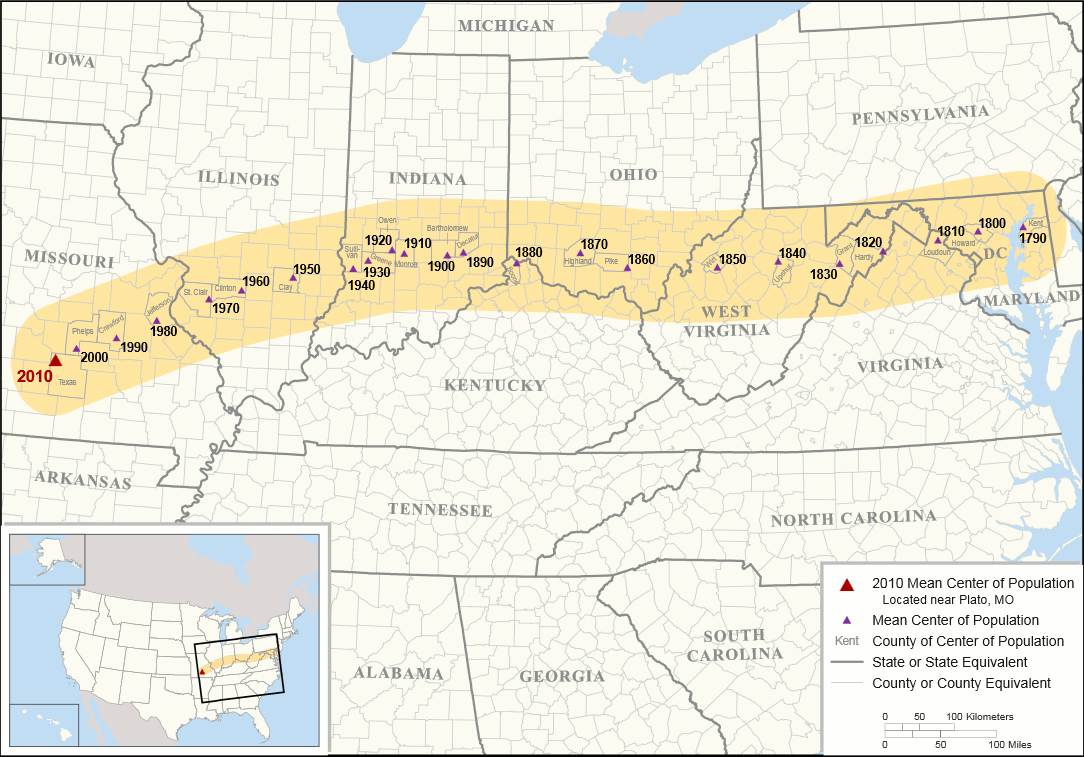
Another of the widely used definitions is the mean centre of population. This assumes that every person in the US is of equal size and weight and are standing on our rigid map (which now weighsnothing). This is, of course, a daft thought experiment because anyone who’s visited the US knows that Americans aren’t uniform size and weight. But assuming that the people in Nebraska are the same weight as the people in New York, this middle of America is near Plato, Missouri. I absolutely love this map - it tells so much with how the middle has moved since 1790 – showing the Louisiana purchase, showing the growth of the industrial north as it pulls towards Chicago and Detroit, showing the growth of California since 1900, and Texas and the south since 1950 along with the decline of the the rust belt.

We were pretty much half-way between these two middles of America, in Lawrence, Kansas, last week. I was still suffering the ill effects of eating the Froot Loops and needed something tamer, safer, less sugary, less out of control.

One of the really traditional US cereals is (or do I mean “are”?) Cheerios. These have the same form as the Froot Loops, little crunchy donuts, but are the colour of real food, and have been an American staple since long before I first came to America. When I ask normal people what their favourite cereal is Cheerios (or one of their offspring, like Honey-Nut Cheerios) tend to be the most common answer. They are very “Middle America”.

A bowl of perfectly normal food. Wow.
These were the first oat based processed cereal ever made, and are a proper cultural icon: all the way from Charlie Brown being their mascot to Sue Sylvester’s cheerleading team on Glee being called The Cheerios.  Everyone knows what they are, and they’re held in high esteem across the board. Not everyone loves them, but they are respected. A bit like Weetabix in the UK, I guess.

Beth tells me that they’re the snack food for young children in this country: that you can’t find a stroller or the backseat of a minivan without Cheerios stuck to it.

I pretty much knew what I was expecting here – which is the reason I went for them – a taste of actual cereal, crunchy, filling, not too much sugar. Something safe.

Unsurprisingly, I was mostly right, given that I’d eaten Cheerios before. They are good. Really very good. They taste of oats, they’re crunchy, and they’re pretty delicious. It’s a full flavour, with just a little nuttiness.

The only other thing of note was that they’re just not sweet enough for me these days. People eat Cheerios unsweetened which is just a little too cardboardy for my tastes – I had to add a little sugar, and they became properly delicious and simple. I’m expecting some of the derivatives to be up amongst my favourite things on my quest. This is actually good breakfast cereal.

Scoring:
Culinary Integrity – 9. They are actually real food. Nice, high quality and tasty. Tasting of real ingredients.
Pleasure to eat - 7. Not only are they real food, but pretty good to eat. There isn’t anything actually exciting here. Fairly mundane. But good.
Bonkers Americanness – 2. Despite being basically an American staple, they just aren’t at all mad. There’s no insanity at all. 

Thursday, 24 November 2011

The Dark Heart of America


Fear in a box

Like a modern day Marlow, I’ve ventured into the heart of America, literally and figuratively. Yesterday we travelled 800 miles across New Mexico, Oklahoma and Kansas, into the deepest middle of America, US Route 56 my Congo River: it was all those things you imagine about prairies and plains and dustbowls. And today I ate Froot Loops.

On the literal front, the heart of America is not at all dark. It’s surprisingly beautiful (although perhaps it would get boring after a while) – big wide expanses, the mountains changing to rolling hills slowly flattening out as we headed east; immense grasslands with the occasional windmill presiding over them. The people were friendly. And the sky was huge - an immense canopy of blue and brightness.

On the figurative front, though, the heart of America is black. Anywhere that can dream up the Froot Loop, let alone sell it, let alone choose to buy and eat it, is a sick, sick, sick place. It’s wrong in the head, wrong in the soul. The very fact of Froot Loops makes me scared to be in this country.

My expectations were low, very low - sufficiently low that I chose the lobby of a Hampton Inn to experiment with this monster. I pretty much knew that I had no desire to buy or eat an entire pack, and the hotel kindly offered a mini-pack. The name and colours told me that it would be deeply fake and suggested it would be deeply unpleasant.

Fear in a packet
My prejudices were entirely correct. Except that the colours were perhaps more hideous than I’d even thought from the packet and the advertising. Luminous and yet washed out. The packet advertises “Good source of fiber” and “Made with whole grain”, as if this is a health food. You can tell how healthy Froot Loops are going to be by checking out the ingredients list. Item number one, the main ingredient, is “Sugar”. How can you actually make something that stays stable in milk rather than dissolving when it’s made primarily out of sugar? There has to be some brilliant industrial chemistry at work – unfortunately, brilliant chemistry doesn’t always mean “nice” or “tasty”. Perhaps that chemical stabiliser is “Froot”. Froot certainly bears little resemblance to the similarly pronounced “Fruit”.

Leopold II in a bowl
So how do they taste? Nasty. Immensely, immensely nasty. Unutterably nasty. Vile. Hideous. They are quite lightweight and dry, like a dehydrated sponge mixed with cardboard. But the texture isn’t the big problem. The problem is the flavour. They taste a bit like fruit flavoured sweeties, like Starburst or Refreshers in the UK. Except weaker, washed out – it has all of the bad flavour, but somehow watery and more chemical. Yet it manages to get worse, because now you’re putting dry, bad, washed out Starburst, with none of the acid you’d actually like from fruit that gives it life, into milk. Why? Why oh why oh why? What would possess you? What kind of sick, diseased nation would produce this?
The author after a mouth full of cereal hell
Like some 19th century European observer seeing the Congo Free State as a glorious, highly productive nation indicating what might come from the future of Africa, unaware of what was going on in the interior, people outside might see the US as a global superpower, the home of so much of the music we listen to, of movies, of awesome scenery, of hamburgers and hot dogs, of almost all the technological innovation we see, of space travel and air travel, a wonderful, magical awesome country. But they don’t see that this is a country that eats Froot Loops.

One positive note: for once the “portion size” is not too small. There is no way that any human could eat an entire portion of this stuff.

Wow. That is all. Wow.

The scores, should we need them:

Culinary Integrity: 0. Nil. Nothing. Zilch. Blegh.
Fun: 0, again. There’s just nothing redeeming at all.
Bonkers Americanness: 10. Full marks for insanity. Look at the colours. Think about what kind of person would even try and create this. It is the work of a crazed evil genius.


Thursday, 17 November 2011

Waffling on


Real and Fake flavour!
A while back, I was watching Heston Blumenthal’s TV show where he was trying to produce the perfect food for British Airways. Apparently flavours become less pronounced in the pressurised cabin. I checked what the cabin pressure is on a standard airliner, defined as “effective cabin altitude”: generally it’s kept at the equivalent of 7000 feet. The other factor that Blumenthal was concerned about in an aircraft cabin was the very dry air.

Here in Flagstaff, Arizona, at the edge of the Colorado Plateau, we are at 7000 feet. We are in the high desert, with a super-dry atmosphere. It should, effectively, be the same as inside a 747.

This means that we should have the same flavour and taste impairment as your average airline passenger. Blumenthal ran some experiments that suggested that the ability to taste the four standard flavours of western cuisine (sweet, salty, sour and bitter) are heavily suppressed in aeroplane conditions, yet the ability to taste umami (the savoury flavour) is untouched. This means that you should be eating shiitake mushrooms with wasabi and parmesan when you’re at altitude.

What does this all have to do with breakfast cereal? My feeling is that my tastebuds are impaired. Horribly impaired. The second cereal in my attempt to work my way through the aisle is Kelloggs Eggo Cereal. And, disturbingly, I thought it was pretty good.

Prior to tasting it, I wrote this as my prediction:
How is this going to work as a cereal? Well, I honestly have no idea – I think it might be better, earthier, less fake than the Reese’s. Waffle is a fairly plain base flavour. I’m mostly scared of the artificial maple, which might be very chemical indeed if it’s not just sugar syrup. I’m really pretty optimistic, though.

Eggo are a brand of frozen waffles that Beth loves: the kind of thing that has almost no flavour and whose texture is pleasing but deeply artificial. The conversion into a cereal seems a bit bizarre, given that waffles are already a breakfast product. So it appears to be entirely redundant.

To my surprise, the cereal actually tastes quite good. You will see on the packet that they proudly proclaim that the cereal has “natural and artificial flavor” which seems very odd to me as an advertising gimmick (if you think the natural is good, surely you’d want to shut up about the artificial?). And it really scared me. Artificial maple is not always a good thing, and here in the US syrup isn’t even maple at all, but is just a sugar solution.

My guess is that, in finding the Eggo not too sweet, and finding the maple not too disgusting, the altitude is at work here. So I suggest taking my review with a pinch of salt (or, I suppose, parmesan...). I particularly doubt my ability to taste the sugar given how I once again had a sugar-crash a couple of hours after eating. And, unlike the Reese’s, I didn’t overfill my bowl. This time, the portion size isn’t quite as outrageously small. It is one cup – not enough to make you full, but not as laughable as the ¾ cup that Reese’s suggested.


One meagre-looking portion of Eggo

What I could tell of the flavour was that there was nothing waffly at all, the maple was pretty authentic and not too dominant. The texture was nice, but the Eggos got soggy very fast, even faster than I could shovel them into my throat. I think that was the worst of it. They really aren’t bad at all.

One laughable discovery came on the back of the packet. Every “fun” cereal has to have some kind of entertainment on the back of the packet – I suspect the most reading that some people do in a day is the back of the cereal box – and Eggo have come up with a marketing tagline below. Now, I don’t know who thought this up, but surely the target market for this product haven’t been listening to their Huey Lewis and The News mix too often...


The scores on the doors for Kelloggs Eggo Waffle Cereal are as follows:

Integrity: 6 (with altitude related caveats). Good texture, mapleness is solid and realistic, maple and waffle are naturally related flavours so it goes OK. There’s clearly too much sugar for a higher score, given my later-in-the-day shakes.

Fun: 7 – who couldn’t be excited by maple waffle cereal as an idea? And nicely crunchy. Nothing entertaining in the colour department, though.

Only-in-America: 9 – who else would even think of this? The frozen waffle is itself a US-only concoction. Maple is a very American sort of flavour. And the idea of turning a breakfast product into breakfast cereal is something only an American would even consider.

Friday, 11 November 2011

Land of Milk and Humvee

One thing I’ve found since getting to America is how easy some things that used to be difficult are, and how difficult some things that used to be easy are. Recent experiences highlight both ends of that spectrum.

I commented when writing about the Reese’s Puffs about how they float in the milk. What that means is that there’s almost inevitably some milk wasted, left at the bottom of the bowl. As it happens, this is not too much of a problem – because here in the US it’s almost impossible to buy a “pint of milk”. The first problem is working out what “milk” is. It’s something I’ve noticed in the past. You can buy skim milk, 1% low fat milk, 2% reduced fat milk, calcium enhanced milk, vitamin D enhanced milk, half and half (which I believe is half cream, half milk), fat-free half-and-half (which I believe makes no sense), soy milk, buttermilk, enhanced calcium fat free soy milk, lactose free milk (no, really...). But nowhere is there “milk”. Regular, normal, everyday milk. At least, that’s how it appears.

I have learned that all milk in the US is enhanced with vitamin D – like fluoridation of water, years ago some US government agency decided that the best way to get the public to consume certain things is by just sneaking it in to widely eaten food (iodine in salt, folic acid in grains). “Trying to put foreign substances into our precious bodily fluids” as General Jack D Ripper might have said. All of which means that “Vitamin D Enhanced Milk” is what we would call milk.

At least now, that problem is resolved – I can buy milk.

But even so, I’m not sure that you can buy just a pint. In most of the supermarkets it appears that the smallest amount of milk you can buy is half a gallon. We have seen a 2 pint container. 1 pint, a portion size suitable for one person, just doesn’t seem to be available. We’ve noticed this with other groceries, too. It is really, really hard to buy one meal’s worth of food. We bought the smallest packets of green beans we could find a few days ago, and despite feeding four people for three meals we are only half-way through. It appears that the grocery stores here assume that you’re catering to a family of 16, you’re happy to eat the same thing for 6 consecutive days, or you’re happy to throw huge amounts of food in the bin. It’s nearly impossible to just buy enough food for two people for one dinner.

In contrast to the difficulty of buying a pint of milk, it was astonishingly easy to get a driving licence. There is no way that I am safe to drive in the US, less still in the immense SUV that we bought, driving an automatic transmission when I have no idea how to. Yet the Arizona department of motor vehicles seemed almost desperate to get me licenced. I had thought that as a foreign tourist it would be impossible, I’d need a social security number, a permanent address, and many other bits of bureaucracy. But no: just show them the passport, and pass a pretty basic multi-choice test (take 10 minutes reading the Arizona highway code, and you’ll be fine), and then you’re sent out with an examiner. Unlike in the UK, where you have to wait weeks and weeks for appointments, here in Flagstaff I just walked in, and an hour later was taking my test. Which was: drive around the parking lot. Parallel park between some orange cones (and even then, the examiner told me I was slightly missing and then told me when to turn the wheel, which I think showed how desperate she was for me to pass). And then drive around the block. Left turn, right turn, left turn, left turn, right turn back into the parking lot. And that is it. I have an Arizona drivers licence. With a pretty picture of the Grand Canyon on it.

Now I have my driving licence, I’m delegating most of the driving back to Beth – both of us are more comfortable that way.

Yesterday, we went on our first visit to Walmart, and I admired the range of ludicrous cereals on offer. It fills me with hope that this blog actually makes sense. Whilst there I chose to buy my second box of cereal. I’ve not quite finished the Reese’s yet, but next on the list... well, you’ll have to wait until tomorrow to find out what it is.

* Note: The title has some artistic license for the benefit of punning

Sunday, 6 November 2011

The March of 1000 Miles Starts With a Single Bowl of Peanut Butter Cereal


My first cereal: Reese’s Puffs. Why did I choose these? For my first bowl I really do have to have something that looks incredibly American. What better than the cereal form of the Reese’s Peanut Butter Cup?

Reese’s have been diversifying like mad recently, with any number of forms of the peanut butter cup appearing – giants, miniatures, selects, in cookies. So perhaps it’s no surprise they’ve ventured to the cereal aisle, too. Peanut butter cups are delicious, peanut butter and chocolate making a fantastic taste-pairing, so part of me expects everything Reese’s touch to be wonderful.

What do I really expect? As someone who’s not a fan of chocolate at breakfast (except in a pain-au-chocolat) my hopes aren’t high. I’m expecting something crazily sweet, which colours the milk making even the milk nasty. I do expect the peanut butter to elevate the cereal a bit, and make it edible enough for me to finish the pack. But the puffs will be way, way, way too sugary.

And the reality? Much better than I expected, but hardly perfect. There isn’t that disgusting fake-chocolate flavour that I feared. They have a really nice crunch, and a good grain-flavour under the peanut-butter. The peanuttyness is very welcome, and a bit like those peanut puffs you get in France or Germany as a salty snack to go with your beer. Also on the positive side, the crunchiness remains while in the milk.

On the other hand, remaining crunchy is actually quite easy if the cereal floats, keeping part of it above the milk-line never getting damp. Which the Reese’s Puff does. I’m not a fan of floating cereal; it makes it hard to mix properly with milk, and it also gives a false impression of how much you’ve got left in the bowl.

Which brings me to an ongoing complaint of mine: portion size. Apparently in a packet of Reese’s Puffs, there are 12 servings. And, they say, a serving only has 120 calories implying that this is a perfectly healthy, low calorie, diet breakfast. 12 servings my arse! A serving is, I read on the side of the packet, ¾ of a cup. You can see in the photo below what that actually means. It barely covers the bottom of a bowl. Is this really an amount of food anyone thinks will be suitable to set you up for a day.


One "portion" of puffs


Also on the negative side is the cloying sweetness. Whilst eating them, the puffs seemed to be fairly normal and quite pleasant, but now – 20 minutes after finishing the bowl – I have a nasty, sticky, almost acidic sweetness at the sides of the tongue and inside my cheeks. My mouth is just reacting against the overpowering sugar that is in these things. They may be OK to eat, but the aftertaste (perhaps even aftermath) is grim. There’s an artificiality that you don’t pick up at the beginning, too, but which grows and grows. In principle, I don’t object at all to artificial flavouring and sometimes find it quite wonderful, but when it tastes like someone has emptied an 8 year old’s chemistry set into my mouth – as this does – it’s not for me.

The scoring for the first cereal is as follows:

Culinary Integrity: 4 (for the peanut and the corn, mostly)
Fun: 7 (very fun to eat, but much less so in the minutes afterwards)
Bonkers Americanness: 8 (Very high in terms of American, less so on the complete madness side of things)